
Trailer Bearing Repairs: Helping Customers Choose DIY or Workshop Service
A trailer that starts to rumble at highway speed forces a decision most owners put off: book the bearing job into a workshop, or do it at home. The honest answer depends on the trailer, the tools on hand, and a clear picture of what the work actually involves. It is the same assessment a good service advisor walks through with a customer, and it holds up just as well for an owner standing in the driveway.
Why trailer bearings wear out faster than car bearings
Trailer bearings wear from sitting as much as from towing.
The automotive bearings in a tow vehicle work almost every day, and modern car hubs are sealed units that never ask for attention. Trailer hubs run serviceable tapered bearings packed in grease, and the trailer itself might sit for weeks or months between trips. During that time, the grease settles and moisture condenses inside the hub. Corrosion starts on the race surface well before the next trip, and the first tow of the season runs those marked races under full load.
Then there is the load itself. Bearings must suit the hub and its rated loads. A caravan running close to its Aggregate Trailer Mass asks sustained work of the bearings at highway speed for hours at a stretch. Tandem axle suspension spreads the weight across more wheels, but tight turns still side-load the bearings, and there are twice as many hubs to maintain.
Boat trailers add the harshest condition of all. A hub that is warm from the road gets backed into cold water, the air inside contracts, and water is drawn past a tired seal. Salt water turns a small breach into fast damage, which is why double-lip marine seals exist.
The warning signs worth acting on
A worn bearing rarely lets go without warning. The signs are consistent, and they show up well before the failure does.
Noise usually comes first: a metallic rumble or growl that rises with road speed and often changes through curves as the load shifts across the trailer. Customers frequently describe it as tire hum, so have the hub inspected before towing again.
Play comes next. With the trailer jacked and the wheel rocked at top and bottom, a small amount of end movement is built into a correctly adjusted hub. A visible clunk means the adjustment has gone or the bearing is breaking up.
Heat is the check anyone can do. After a run, each hub should feel warm at most, and one that is too hot to touch or clearly hotter than the other side is in trouble. An infrared thermometer makes this easy on long trips: a quick reading at each hub during a fuel stop catches a failing bearing early, when it is still a straightforward repair.
Grease weeping from the back of the hub is the quiet one. It means the seal has failed, and grease that can get out lets water get in. A workshop that hands a customer this list gives them a way to catch trouble early.
What a DIY bearing service actually involves
None of this puts the job out of reach of a careful home mechanic. It does mean the choice should be made with open eyes, because a bearing service is slow, messy work with standards that do not bend.
The tools and the mess
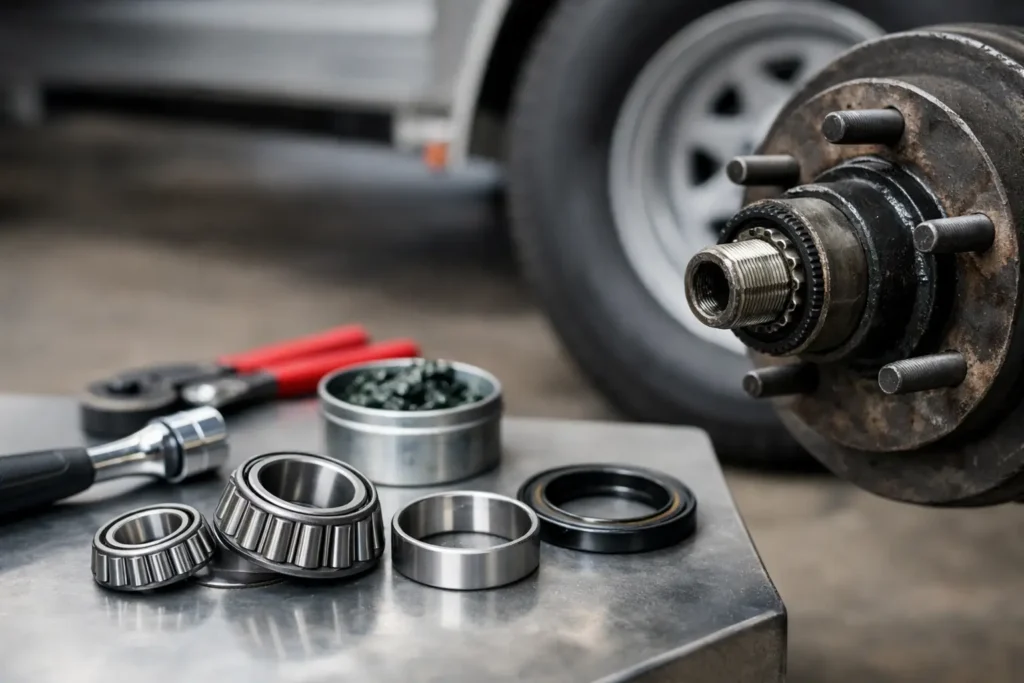
A hub service needs more than a socket set. The working list runs to:
- A floor jack and rated stands. Never work under a trailer supported only by a jack.
- A drift punch and brass hammer, for driving out the old races without chipping the hub casting.
- A seal puller, solvent and a washing tray for stripping out old grease.
- Rags in serious quantity, plus nitrile gloves and eye protection.
- High-temperature marine grease, new seals and new cotter pins.
- A grease gun, if the hubs run bearing protectors.
- A clean bench or tray for the packed bearings, because a greased bearing dropped in the dirt starts the job over.
The mess is real. Old grease coats everything it touches, the cleaning takes as long as the mechanical work, and the job ends with a pile of black rags and a solvent tray to dispose of properly. A first attempt at a full axle can fill a day, and an experienced hand moves much faster. That gap is worth weighing honestly.
The steps that decide whether the job lasts
A workshop bearing service covers the same ground in broad terms: the hub comes apart, everything is cleaned and inspected, new bearings, races and seals go in, and the assembly is adjusted and secured before the wheel goes back on. What a customer is paying for is the judgment inside that sequence, since a worn spindle or a damaged hub can turn a routine repack into a larger repair. Before booking, it is worth asking what the quoted price includes, whether the shop inspects the spindle and hub or only swaps parts, and whether new seals and hardware are part of the job or billed separately. A shop that answers those questions plainly is usually a shop that does the work carefully.
Each of those steps carries a standard. Grease left behind can react with the new grease. A race driven in crooked scores the hub casting. An air pocket in a packed bearing becomes a hot spot under load.
The job punishes hurry.
Getting the parts right
Replacement bearings are standardized, and the number is stamped on the cone itself. Inner and outer bearings on the same hub are often different sizes, so both numbers need checking before anything is ordered. Owners who measure their hubs and spindles first can search those numbers alongside a phrase such as “trailer parts online australia” to match the right bearings and seals to their hub.
If the numbers have worn off, the fallback is measurement: spindle diameter at both bearing journals, the hub bores and the seal surface. A set of calipers and careful notes beats guesswork, because a bearing that is close to the right size is still the wrong part. The old cone, kept as a sample, settles any doubt at the counter.
Cup and cone always go in as a matched set. A new cone running on a worn cup fails early, and the few dollars saved by reusing the old race go with it.
Boat trailers deserve the marine hardware: double-lip seals and high-temperature marine grease as a baseline. Bearing protectors are worth adding where they suit the hub. A spring-loaded protector keeps the grease under slight pressure, so water is less likely to be drawn in at the ramp. It does not remove the need for inspections.
Quality parts stretch service intervals. The price gap between a known bearing brand and an unbranded kit is small next to the cost of doing the job twice.
The mistakes that ruin home bearing jobs
Workshops that handle bearing repairs see the same handful of failures come back on recovery trucks.
- Over-tightening the castle nut. Too much preload crushes the rollers against the race, heat builds fast, and a brand-new bearing can be destroyed on its first long tow. Too little preload leaves play that hammers the races.
- Reusing the old cotter pin. It is a single-use part that costs cents, and a pin that has already been bent once is a weak pin.
- Mixing grease bases. Some grease thickeners are incompatible, and the blend can soften and bleed out of the hub. Complete removal of the old grease is the only safe starting point.
- Reusing seals. A seal that has been levered out of a hub does not seat the same way twice, and the seal is all that keeps water away from the grease.
None of these errors feels wrong at the time. Each one shows up later, usually at highway speed and usually a long way from the driveway.
What a workshop adds
A workshop labor charge covers several things besides parts.
Part of it is repetition. A mechanic who sets bearing preload every week does it by habit, with press tools and a parts washer within arm’s reach, and what fills a DIYer’s day takes a fraction of that time on a hoist. Most trailer and automotive workshops keep common bearing kits on the shelf, which keeps turnaround short.
The job also brings an inspection. With the hub off, a mechanic looks at the brakes, the suspension bushes, the springs and the spindle in the same visit, and that is often where other worn parts turn up.
The warranty is another part of the charge. A bearing job done at home relies on the owner’s own workmanship, while a workshop may stand behind its labor; check what the workshop actually covers. A faulty bearing itself remains a matter for whoever supplied it, either way. That cover matters most when the trailer is a long way from home.
For a customer who tows heavy loads over long distances, or who does not have the tools, the workshop price buys back a day and removes the doubt. For a workshop, laying this out plainly can turn a price query into a booking.
Matching the job to the trailer
A fairly consistent pattern comes out of all this.
Light utility and garden trailers are natural DIY territory. Their hubs are small, the bearing sizes are common, and the consequences of a learning curve are modest. An owner who does one of these well has the skills for bigger jobs later.
Boat trailers sit in the middle. The work is the same, but the sealing standard is higher and the hubs need checking after every launch. In salt water, small sealing failures turn into bearing failures quickly.
Heavy tandem-axle caravans running near their ATM, horse floats and commercial trailers belong in a workshop. The loads are higher, the hubs are doubled, and for a working trailer the downtime costs more than the labor ever will. A workshop that says so plainly is giving good advice, and a customer who hears it has a good reason to take it.
Either route, done properly, ends with a hub that runs cool and quiet. The unsafe option is hearing the rumble and towing anyway.